

Need!
Sermon on John 4:1-42 preached at St Paul's, Ashgrove, for the Third Sunday of Lent

Decades ago when I was spending most of my time in ministry with university students, I discovered something that might have taken me longer to notice in a different setting.
I saw young people faced with challenges – I don’t mean little things, I mean big things, things that any of us would find hard to manage, things like bereavement and violence and serious mental illness – and again and again I would see them
Take up smoking
Start drinking heavily, or taking other drugs
Form unhealthy relationships
Binge on chocolate
Or stop eating
As I watched this pattern, my heart would break because people who were hurting were opening themselves to further hurt. After a while I saw a pattern. The things that offer immediate relief usually make problems worse.
When people are hurting, they often reach for something to make them feel better right now. But the tools closest to hand for these young people were habits that inevitably increased their pain.
Short term relief
Followed by increased pain and need for more relief.
This is an addictive spiral that can spin a young life out of control, but not just young lives. I started looking at my own responses to the pain of anxiety, grief, rejection, disappointment. What was my first instinct? What did I tell myself I need, in those seconds before my better judgment kicked in? Was it a healthy practice that had been clinically proven to promote wellbeing in the long term? Or was it something that might bring immediate relief but would surely add longer term pain?
That is what the spiritual disciplines of the season of Lent are about: practicing habits that we know are healthy but that never seem to be our first thought
Turning to God
Turning to each other
Asking for help
Offering help to someone who needs it
Learning to tolerate the pain and fear and emptiness
So often the things we turn to instead are related to eating and drinking:
Foods too heavy in sugar and fat and salt
Drinks too heavy in alcohol or caffeine
Most of us have a complex relationship with food and drink.
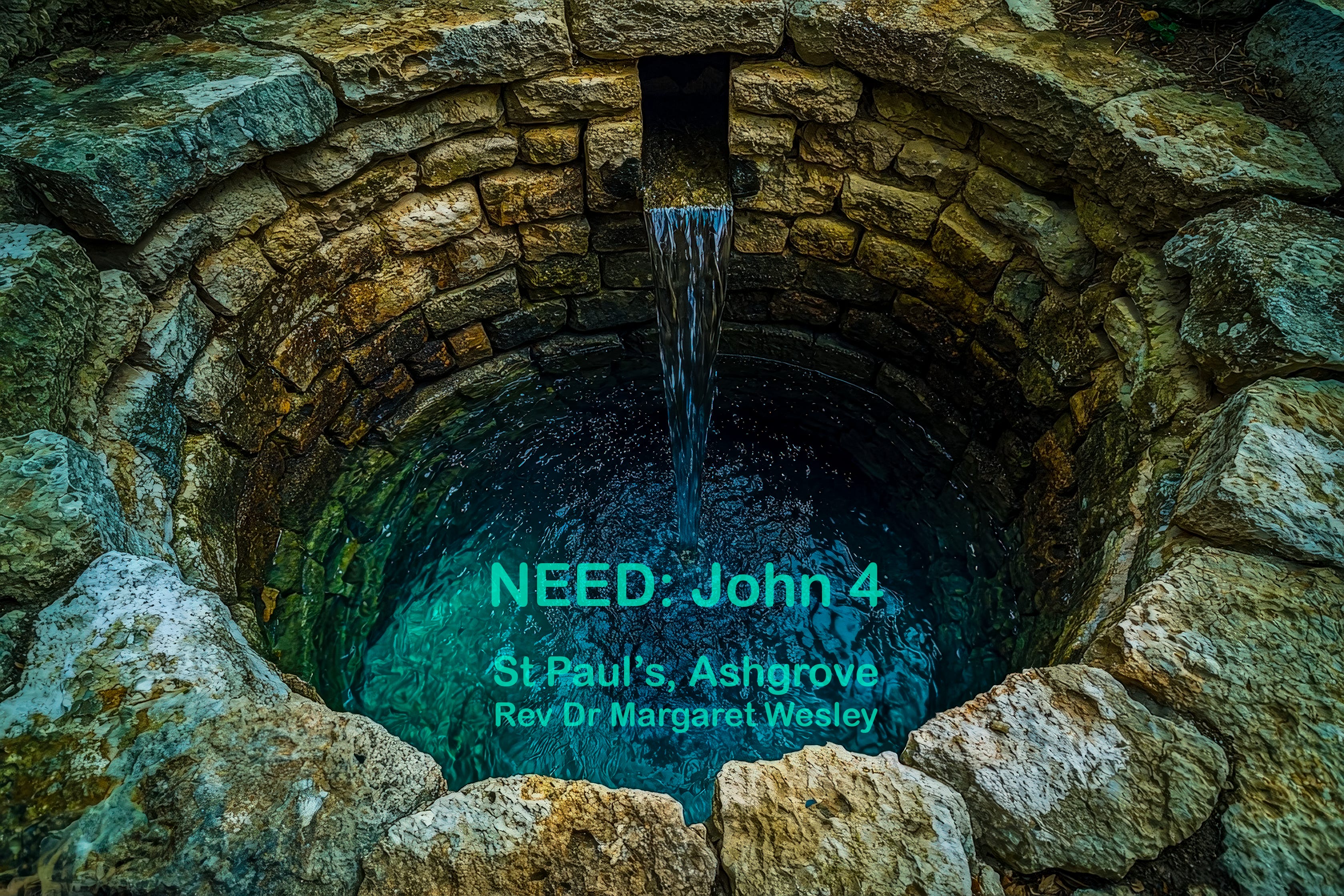
Our reading from John 4 this morning invites us to look closely at hunger and thirst. It asks, “What is the food that really satisfies our hunger? What is the drink that really keeps us alive?”
The passage begins with Jesus experiencing fatigue, hunger and thirst, just like we do. His thirst takes him to a well outside a small town in Samaria.
He asks a Samaritan woman for a drink. There are all sorts of cultural taboos he is breaking as he does that. The woman identifies one of them. A Jew wouldn’t normally drink out of the same cup as a Samaritan. Her words suggest that any other Jew would have preferred to die of thirst rather than asking one of their enemies for a drink. That may or not be true, but this is a sharp reminder of something that will always prevent flourishing – the insistence on keeping enemies at a distance.
Verse 27 says that when the disciples returned, they were astonished that Jesus was speaking with - not a Samaritan, but - a woman, but they were too polite or embarrassed to say anything.
Perhaps the disciples are used to Jesus ignoring racial boundaries, but the boundaries that protect good, righteous men from the dangers of sexual temptation – well, those are really important boundaries, really practical, useful boundaries. But not according to Jesus.
Jesus knows that the thirst that is common to all humanity is a need around which all humanity can unite. Thirst is what connects him to this woman. So he says to her in verse 10, “You think it’s strange that I asked you for a drink? If you knew who I was, you would be asking me for a drink and I would give you living water.”
Then Jesus asks her to get her husband, and she replies that she has no husband.
In the first century, in the majority of families, labour tended to be somewhat divided along gender lines. The men grew crops, looked after livestock and worked in a trade; the women made the men’s produce into food and clothing, bought and sold produce at the market and, of course, went to the well for water. It was difficult for anyone on their own to manage all the tasks required to get by. It was difficult for a man to live without a woman; and it was difficult for a woman to live without a man. Their need for each other was much more than sexual, and certainly more than romantic.
This woman had no husband. This would make her life difficult. It may also make her an object of pity at best and scorn at worst. Women achieved status in this culture by marrying well and producing sons. This woman may have appeared to have failed in the eyes of such a society.
Jesus says in verse 17:
“You are right in saying, ‘I have no husband’; 18 for you have had five husbands, and the one you have now is not your husband. What you have said is true!”
Marriages ended then, pretty much as they do now, in either death or divorce, but divorces were harder for women to initiate than for men. So, most likely her five husbands have either died or divorced her. That’s a lot of grief, disappointment, and anger maybe.
Her experience echoes that of her people, who have for centuries been subjected to the rule of one empire after another, then abandoned until the next empire comes along.
The man she is with now has not married her. We can assume from this that she has no father or brothers or adult sons to protect her from being taken advantage of in this way; or else they had chosen not to protect her.
So, when Jesus speaks of giving her water to satisfy her thirst, it is clear that he is speaking with a woman who knows what it is to need. She knows what it is to grieve for lost husbands, lost security, lost hopes and expectations.
“Sir, I see that you are a prophet.” She says in verse 19. “Tell me how to fix this mess. Tell me how I can stop feeling so sad all the time. Tell me how to avoid throwing this bucket of water at the woman next door who has ten children and one husband and plenty of money. Tell me how to make my life OK.”
No, actually, she doesn’t say that; and that’s the strangest thing about this conversation. What she actually says is:
20 “Our ancestors worshiped on this mountain, but you say that the place where people must worship is in Jerusalem.”
Despite all that she is dealing with, she senses that her real need had something to do with worship. Instead of reaching for short term relief, she focuses on what is truly life-giving; on worship that strengthens our sense of connection with God.
So, Jesus says, more or less, “Jerusalem is special, but a time is coming when that won’t matter so much. A time is coming when you can seek God in Jerusalem or Sychar or Brisbane, and you will find God wherever you are.”
Worshipping God is about spirit and truth, not geography so much. Worship is a meal God sets before us that nourishes our deepest selves, if only we reach out to receive it – take and eat; take and drink.
But this encounter isn’t only about worship. Worship is the topic they are discussing, but the way they are discussing it is even more important.
Here we find a woman and a man speaking honestly and respectfully together about the most important things. They stay there in the conversation in spite of strict social taboos telling them they should not be together.
Here we find a Samaritan and Jew speaking honestly, respectfully and calmly together about subjects on which their peoples are in violent conflict. They stay there in the conversation in spite of centuries of racial prejudice on both sides that would otherwise keep them apart.
There is so much about this situation that would have made them both feel uncomfortable. But neither of them looks for a quick resolution to the discomfort. They stay with it, like Jacob wrestling with God all night and saying, “I will not let you go until you bless me!”
By the end of this encounter both Jesus and the woman are blessed. The woman discovers that she has sufficient influence in her community to bring everyone to Jesus. And Jesus? Well, after the woman leaves, his disciples offer him food and he says “Nah, I’m good. I’m not hungry any more. Honest respectful encounter with someone I’ve been told to avoid has satisfied a deeper need.”
Jesus hangs in there through the discomfort. The woman hangs in there through the discomfort. And both are nourished. Both are blessed.
Either of them could have short-circuited that encounter by rushing to those habitual easy fixes that promise to make us feel better; in this case, rejection on the basis of ethnicity and gender. But these two conversational heroes refuse to take that path.
Those short-term fixes are not just a thing individuals do. They are societal. When the world gets uncomfortable, we see whole groups of people reaching for old prejudices like an anguished person reaching for a bottle. And it seems that sexism and racism are a narcotic that helps some people feel more comfortable for a while. I guess those things help some people make sense of life when the world gets confusing. But they are so short term, and the long-term harm is devastating for the whole society.
We can feel compassion for people whose inner hunger and thirst are so intense that they would reach for such toxic narcotics, which can never satisfy. We can feel compassion for them, but for ourselves we can practice choosing a healthier diet – a diet of genuine, respectful encounter with people we don’t feel comfortable with; hard conversations with people we disagree with; careful listening to people we have been told to avoid.
We all know what it is to be thirsty; and we have all taken our thirst to the wrong wells at times; we have all eaten and drunk things that have left us more empty than before. But here this morning we have friends to help us face our hunger. And here this morning we drink living water by meeting each other across all our divisions to worship God in Spirit and truth.
And in a few minutes we will eat a small amount of bread and drink a small amount of wine - not enough to satisfy our physical hunger and thirst, but enough to remind us that communion across the divisions
Of Creator and creation
Of female and male
Of ancient rival and traditional enemy
Is the food and drink that truly nourishes our souls.
Amen
With Love from Rev Margaret
If you find these reflections helpful you probably have friends who would also enjoy them. Help us get the word out:
Rev Margaret is the Parish Priest at St Paul’s Ashgrove in Brisbane, Australia. Like most Anglican churches, St Paul’s struggles to make ends meet while holding on to our calling to generously reach out with the love of God. If you are in a position to contribute to our ministry, please use these bank details: Name: Ithaca-Ashgrove Anglican Parish; BSB: 704901; Acc No: 00004420. Every contribution makes a difference. Thank you!