

Seeing with Compassion
Sermon on Matthew 9:35-10:8 and Genesis 18:1-15 preached at Hope, Ginninderra, for the third Sunday after Pentecost

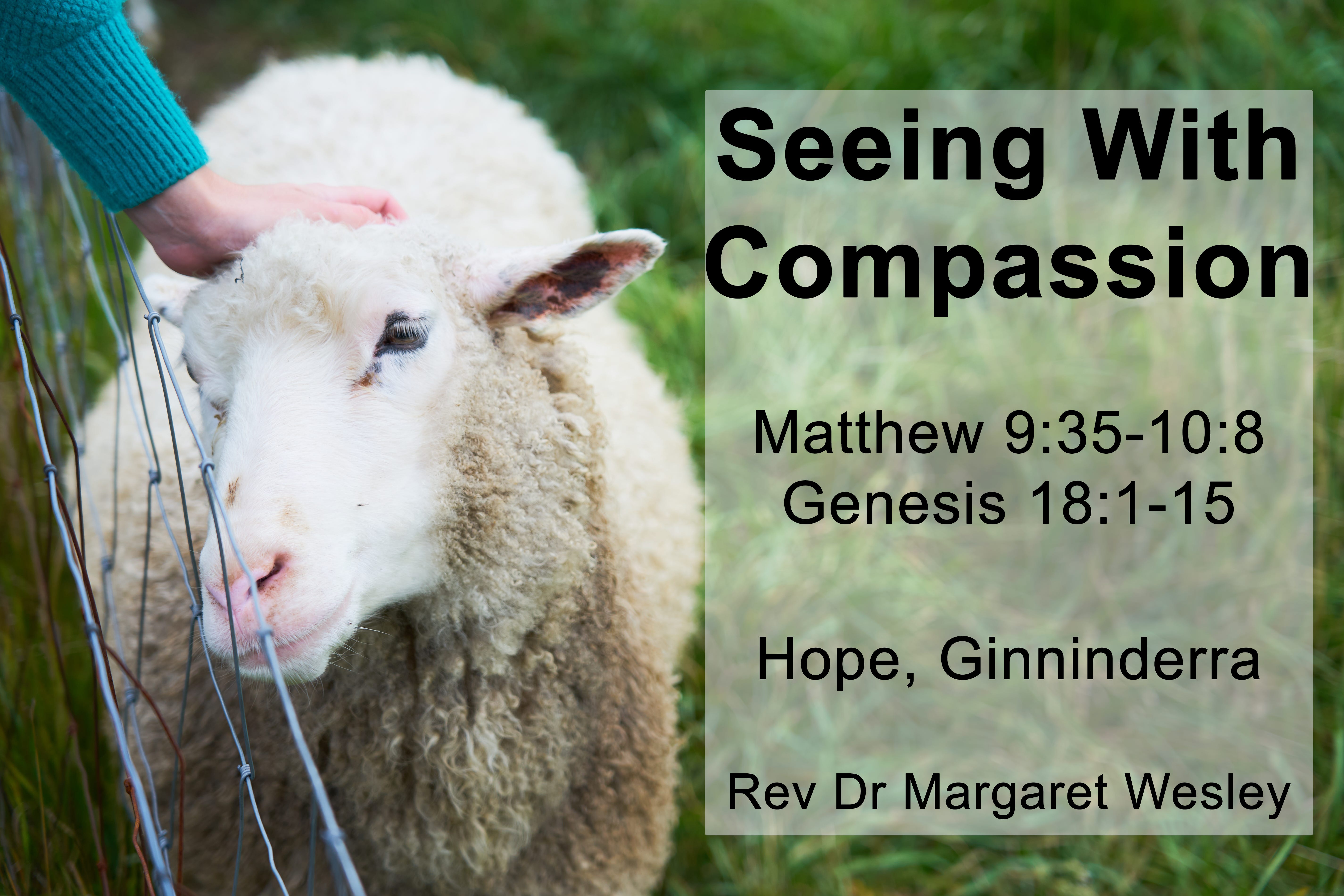
In this part of Matthew’s Gospel we find Jesus wondering around Galilee noticing people and responding to them with emotion and with action.
He notices that the crowds – the ordinary people, the struggling majority of the population – seem harassed and helpless.
I wonder if that sounds familiar to you.
When you look at political trends in Australia, for example, what do you notice?
Perhaps you have seen angry people marching in the streets with banners condemning minority groups that you care about? How do you respond?
Is compassion your first impulse?
Is it mine?
Do we see them as irrational haters, or do we look at them through the eyes of compassion and notice that some of them might be there because they are feeling harassed and helpless, and have been sold a story about who is to blame.
In the streets Jesus wandered through, the issues were different, but not so different that we can’t relate to them. People were struggling. A tiny number were very wealthy, and most were just getting by. People were often seen begging on the streets.
There was a movement of people who were so angry about Roman rule, Roman taxes and Roman land grabs that they were agitating for change and moving in the direction of violent rebellion. And violent rebellion was about to escalate over the next forty years until the Roman army came through in 70AD and destroyed Jerusalem and levelled the temple.
The people were harassed and helpless – under the thumb of Rome and helpless to assert autonomy, because Rome had the biggest army and was always bound to win a physical battle.
Then there were others among the crowd who were trying to make the best of a bad situation – people who had reached a point where the only future they could see for their family was in them collaborating with Rome by becoming tax collectors, soldiers, or administrators supporting the empire that was oppressing their people. Some may have done this without a qualm, but most would have felt they had no choice. They felt helpless, and unable to live the good life they wanted to live, and in their helplessness, they had become harassers of others.
As Jesus wandered through the streets, he saw them all. He paid attention. He ate meals with them. He had compassion. He diagnosed their condition through a lens of compassion:
Not wilfully evil;
Not lazy;
Not inherently violent;
But harassed and helpless.
These were people who wanted to do good, wanted to be kind, wanted to live in grace and generosity with their neighbours, but had been ground down by the political and economic systems that bound them.
We know people like that.
We are people like that, sometimes.
But if we are only looking at the surface of people’s behaviour, we won’t see it. We need to let compassion open our eyes to the struggles people are facing beneath the surface.
In the Genesis reading, angelic visitors challenge Abraham to really see the people of his household, and to reconsider his behaviour towards them.
Abraham sees the visitors approaching and runs around giving orders: he tells Sarah to make cakes; he tells a servant to prepare meat. But when he sits down to eat with the visitors, the servant is not there and Sarah is not there. Only Abraham gets a place at the table with the heavenly messengers.
So, they challenge him.
“Where is your wife, Sarah?” Why isn’t she here?
It is not just that Abraham’s life partner hasn’t been invited to share this particular meal, but that Abraham has failed to honour her as an equal partner in parenting the family of promise.
He had passed her off as his sister in Egypt in a deception that placed her in danger so that he could be safe. And he had fathered a child with a servant girl because he forgot that God’s promises applied to Sarah as much as to him. So Angels turn up to remind him that Sarah is as central to God’s plan as he is, and he needs to open his eyes to really see her; to really honour her.
In Jesus we see someone whose eyes are always open; who really sees people, and sees them through the lens of compassion.
When he saw the crowds he had compassion for them because they were harassed and helpless, like sheep without a shepherd.
Jesus’s response was not anger or hopelessness or moralism or personal sadness. It was compassion. He felt for them. He felt with them. He didn’t blame them for their situation. He didn’t declare a moral crisis. He made a different diagnosis. He declared a crisis of leadership.
Calling people sheep, by the way, was not an insult in this case. In ancient Israel, and in the nations around them kings were called shepherds. Kings were supposed to put the needs of their people – their flock – ahead of their own needs. But they almost never did. And so when we eventually come to the prophet Ezekiel in the Bible, when Jerusalem is destroyed the first time, we read that God had given up on the shepherds of Israel and declared, “I myself will be a shepherd to my people”.
And then in the Gospel of John we see Jesus picking up that promise and saying “I am the good shepherd.” In Matthew’s Gospel we see Jesus acting as the good shepherd and calling his followers to become shepherds.
Jesus acts as a good shepherd by protecting individual sheep – Throughout Matthew 9 we see Jesus healing a paralysed man, a dead girl, a haemorrhaging woman, two blind people and someone who had been mute.
Then, Pharisees condemn Jesus, saying he must have got his power from Satan. Pharisees were not official leaders but were the moral leaders of his day. So when we hear Jesus saying the people are like sheep without a shepherd, that is a criticism of the leadership of those Pharisees and others. If the sheep have no shepherd then the ones who were supposed to shepherd them are doing something wrong.
We can step back and understand that the Pharisees and other leaders were also harassed and helpless, like sheep without a shepherd. They were ordinary human beings like the rest of us, doing the best they could and finding that their best wasn’t enough for the difficult and complex times they were living through.
I’d say that it is true in all times that all leaders who do their best feel like their best is not enough. And the times we are living through may even be as complex as first century Palestine.
There is a criticism of leaders here, but Jesus isn’t saying they ought to be smarter, more strategic, or more organised. He isn’t saying they should read more books and go to more courses on leadership. Those can be excellent things, but Jesus is criticising them here because they have said in verse 34 that Jesus is possessed by the ruler of demons - trying to prevent people from following Jesus.
The people needed their leaders to lead them to their ultimate shepherd, Jesus, where they would find healing, but instead those leaders were standing in the way of the sheep getting to their true shepherd and the green pastures and still waters that he offered.
And as I stand here today, I am aware of being the new leader of a parish with three congregations that each have their own distinct style of worship. I can’t promise that I will never get things muddled or that I will never make mistakes, but what I can say is that I understand that the way your congregation has chosen to hold Sunday services is not just a matter of taste. When you tell me how you like your services to be, I hear that this style of worship leads you to Jesus: this particular way of holding a worship service helps you see Jesus more clearly and helps you believe Jesus is really present with us, and helps you follow Jesus through the rest of the week. If I hear that from you and then say, “That doesn’t matter! We are going to do things the way I like them done”, then I’m not being a good shepherd because I’m not leading you to Jesus.
So let’s be clear about the things that bring you to Jesus and let’s see how we might do those things better and better. And let’s listen to each other and listen to our community and consider what else we might do to lead others to Jesus. It isn’t about being perfect. It is never about being perfect. But we have a great shepherd who is perfect and it is our job to lead people to him.
And that begins with seeing people through eyes of compassion, and when we do that we begin to see the ways in which what looks like inappropriate behaviour may originate with them being harassed and helpless, and then we will want to fix life for them. We will want to give them the food and shelter and opportunities they need. And, if we can, we must do those things. As Helen said last week, every little act of kindness is of great value. And when we commit ourselves to those small acts of kindness we are likely to find ourselves wanting to make the world safer for the people we try to help.
As Archbishop Desmond Tutu said,
“There comes a point where we need to stop just pulling people out of the river. We need to go upstream and find out why they’re falling in.”
When we commit ourselves to that sort of life of compassion, we will probably soon reach the limit of our own capacity. We may feel frustrated. We may show signs of burnout. We may find ourselves feeling harassed and helpless. So, we need to take ourselves to our great shepherd.
We need to pray.
And that’s exactly what Jesus tells his disciples to do:
“The harvest is plentiful, but the labourers are few; 38 therefore ask the Lord of the harvest to send out labourers into the harvest.”
He mixes his agricultural metaphors from herding to cropping but the point is the same: the sheep don’t belong to us; they belong to Jesus, the Good Shepherd. The harvest isn’t ours; it belongs to the Lord of the harvest – to God. So we pray, believing that God cares more about the people around us than we do.
And after telling the disciples to pray, Jesus tells them to make their own lives available as the place where their prayers might be answered.
And that reminds me of a song, Do Something, by Matthew West:
Well, I just couldn’t bear the thought of
People living in poverty
Children sold into slavery
The thought disgusted me
So, I shook my fist at Heaven
Said, “God, why don’t You do something?”
He said, “I did, I created you”
That isn’t the whole story, of course, and we don’t always have to be the answer to our own prayers, but what I find – and I would love to hear if you find this too – is that when I allow my eyes to be open with compassion and I become aware of deeper needs and struggles around me and when I take that awareness to prayer, then sometimes, as I pray, I perceive a call to action. And I have learned to pay attention to those quiet calls – not because I can say with absolute certainty that I have heard the voice of God but because, even if it is the voice of my own heart, there is wisdom there too.
There is wisdom in your heart too. So we listen to each other.
In Matthew 10, Jesus sends twelve disciples out on a mission to heal the sick, cast out demons and preach the kingdom of Heaven.
This little band of disciples, inadequate as they were, are sent to shepherd the shepherdless sheep of God and bring in the overdue harvest of God. And after them the church, inadequate as we are, is called to do the same. We won’t do it perfectly, but we will follow the model Jesus sets out for us in Matthew
We will look at the unruly people around us with eyes of Compassion, not judgment
We will Pray, believing that God is the great shepherd who cares more about the people around us than we do.
We will make ourselves available to be part of God’s answer to those prayers.
None of us does this alone. We do it together as the church. We do it humbly and carefully, knowing how often and how badly the church has sometimes failed at this task. And we remember that our job is not to be the saviour, but to lead people to the one who is the saviour of all.
And we do this remembering that each of us is also a sheep of the good shepherd. We all feel harassed and helpless sometimes. Those eyes of compassion need sometimes to be turned on ourselves. And then we need to shepherd our own hearts back to the Good Shepherd who will guide and comfort. So
May you live in the compassionate gaze of Jesus this week,
May you know the comfort of being a lamb in his flock
And the joy of helping others return to the loving shepherd
Who laid down his life for us all. Amen
With Love from Rev Margaret
If you find these reflections helpful you probably have friends who would also enjoy them. Help us get the word out:
lovely to hear from you again